 by Savi3
Agile promises continuous improvement. But in many teams, improvement becomes occasional — dependent on a good retro facilitator, a motivated team, or a calm sprint.
What if improvement itself became structured, lightweight, and embedded into every sprint?
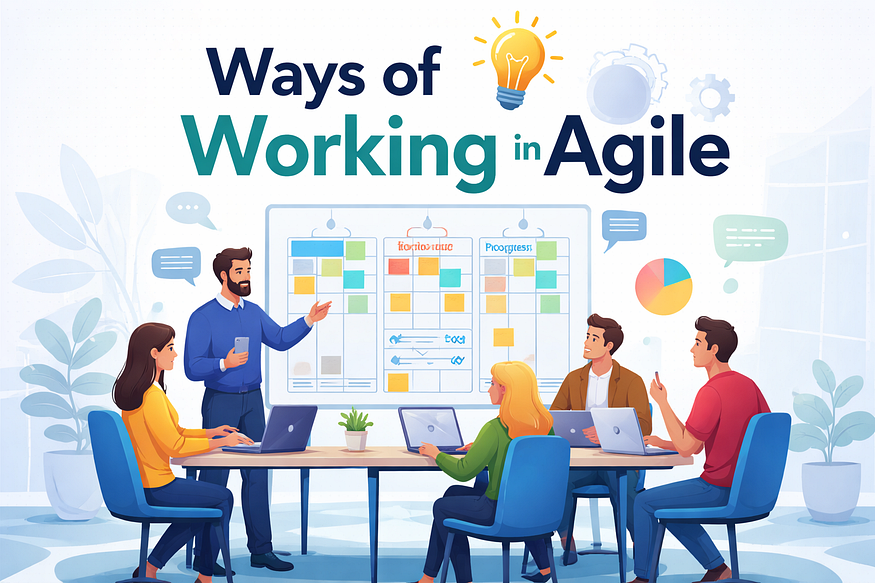
That’s where a Ways of Working (WoW) session becomes powerful.
What Is a Ways of Working Session?
A Ways of Working session is a short (generally 30-min), focused discussion held every sprint where the team asks one core question:
“How are we working together — and what small change would make us more effective next sprint?”
Unlike a traditional retrospective (which can be broad and emotional), WoW sessions are:
- Practical
- Forward-looking
- Improvement-oriented
- Action-driven
Why Teams Need It (Even If They Already Do Retros)
Many retros end with:
- 5 improvement ideas
- 2 unclear owners
- 0 measurable follow-up
When teams become mature, the action points from retros reduce too.
WoW shifts the emphasis from discussion to execution.
Instead of:
“We need better refinement.”
You define:
“Starting next sprint, all stories must have test scenarios before estimation.”
It converts insights into working agreements.
Types of Improvements WoW Surfaces
Over time, WoW sessions typically surface improvements in five areas:
1. Estimation Discipline
2. Flow Optimization
3. Dependency Management
4. Quality Engineering
and most important of all,
5. Communication & Culture
The Long-Term Impact
When done every sprint, WoW creates:
Predictable Delivery:
In the short term, WoW improves small behaviours. In the long term, it stabilizes the system.
When teams regularly adjust:
- Story slicing
- Definition of Ready
- WIP limits
- Dependency handling
- Estimation guardrails
You begin to see:
- Reduced spill over trends
- Lower estimation variance
- More stable velocity bands
- Fewer last-minute escalations
Predictability isn’t achieved through pressure. It’s achieved through iterative system tuning.
WoW is that tuning mechanism.
Root Cause Awareness:
Because patterns are documented and revisited.
Continuous System Evolution:
Because the team’s process improves in small increments.
Higher Team Maturity:
Because improvement becomes shared ownership — not Scrum Master-driven.
Common Pitfalls
- Turning it into a complaint session
- Trying to fix everything at once
- Not tracking whether changes helped
- Skipping it when the sprint is “busy”
- If improvement is optional, it disappears under pressure.
Final Thought
Agile is not just about delivering features faster.
It’s about improving the system that delivers those features.
A consistent Ways of Working session ensures that:
Every sprint doesn’t just ship value. It upgrades the team itself.
In my next article, I’ll break down the structure of an effective Ways of Working session and how teams can run it in under 30 minutes.